November 29, 2024 · Guadalupe Faraj
In 1972, a plane carrying 45 people went down in the mountains of Mendoza. After 72 days, only 16 survived. The expedition to the memorial built at the site is a moving journey that honors this epic story of survival.
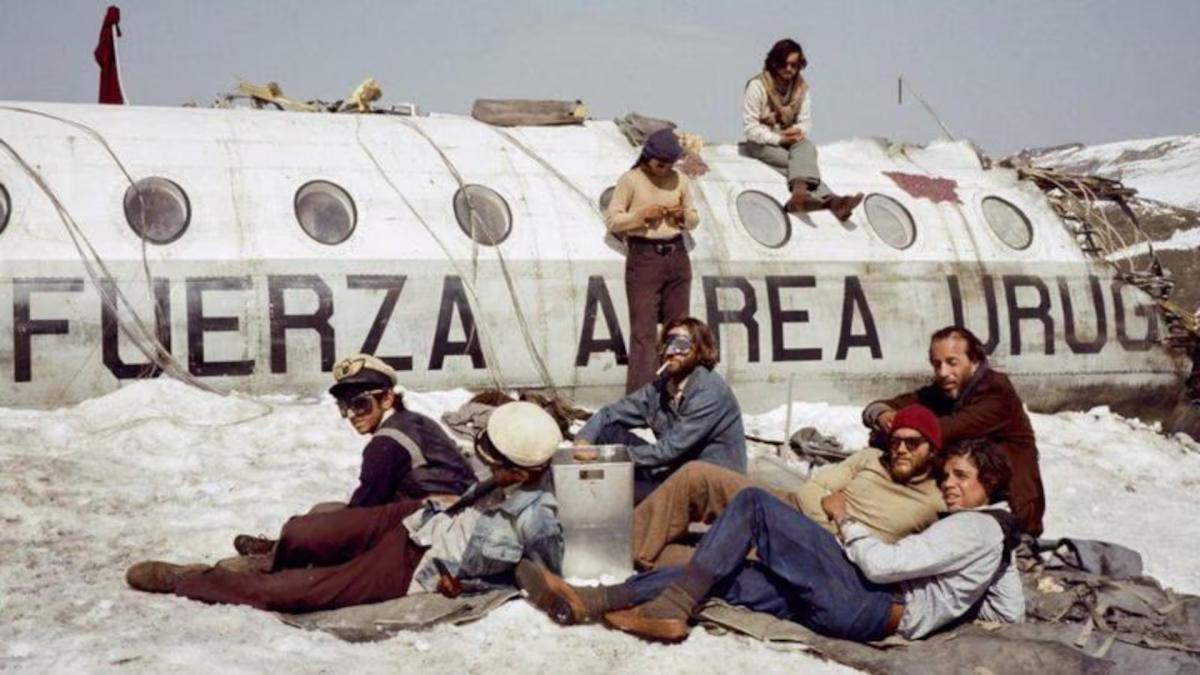
This past October marked 52 years since the tragic end of Uruguayan Air Force Flight 571. The Fairchild FH-227D, better known as “the Uruguayans' plane,” crashed in the Valle de las Lágrimas, Mendoza province. The place gets its name not from the tragedy of the crash, but because the formations on the mountain slopes have grooves that, seen from a distance, look like the tear marks left on a face.
When the chance for this horseback trip came up, I didn't know it was the site where the plane had gone down on October 13, 1972. I hadn't read the books, hadn't seen the movies, hadn't reflected on that event as a paradigm of survival, one of the most significant in human history. Once the trip was confirmed, I did look up interviews and articles, and I talked with people. I remember that one night, already staying in Mendoza after a long workday, I got into the hotel bed, put on my headphones, and didn't take my eyes off my phone screen until two in the morning, when I finished watching Society of the Snow, the film by Spanish director Juan Antonio Bayona.
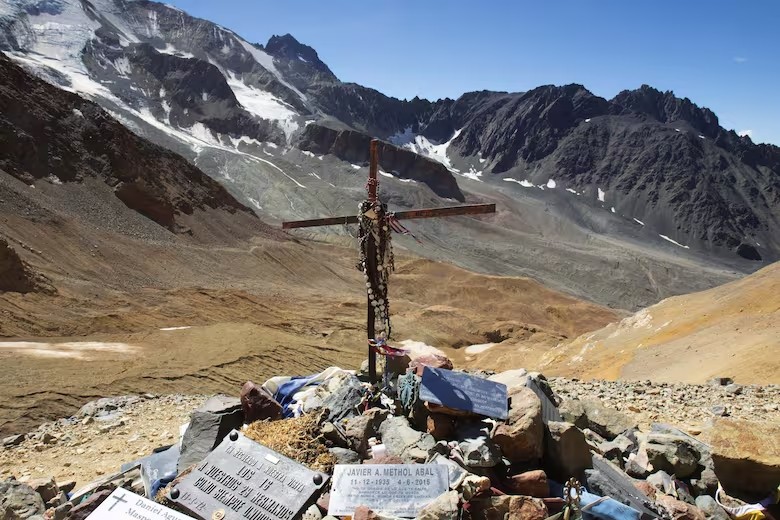
I was ready, or so I thought. I had “immersed” myself in the subject, but I hadn't imagined what it would feel like to arrive at the Glaciar de las Lágrimas, at 3,600 masl –this one, in fact, named in honor of those who died there–: it's the site where the memorial and the remains of the plane are found. Fernando Robledo, owner of the Argentina Extrema agency, had warned us from the start. “On every mountain expedition we have a goal: reaching a summit or crossing the Andes. This one, though, isn't a goal you celebrate once you achieve it.” The aim is to reach the memorial, but once you get there, there's nothing to celebrate. “Unlike other treks, on this one the culminating moment is one of silence.”
Argentina Extrema is the agency Fernando Robledo dreamed up at 19. A lover of rock climbing and adventure activities, at that age, while studying Computer Engineering, it occurred to him that he could start a venture offering this kind of trip, but back then he only saw it as a distant dream. “The real starting point was in 2011… One of the first products was the Valle de las Lágrimas, around 2012. We couldn't do trekking in Argentina without offering this one, which was a dream for us too, to be able to reach that place.”
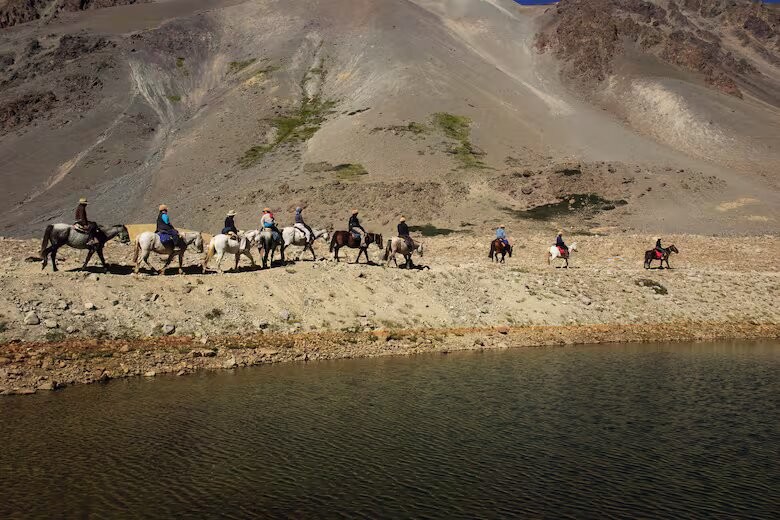
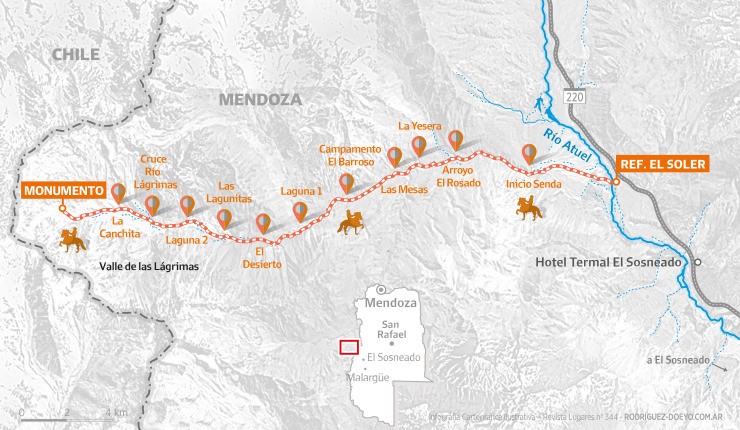
The expedition to the Uruguayans' plane comes in two forms: trekking or horseback riding. It lasts three days, and the first meeting point is in El Sosneado (137 km from San Rafael and 52 km from Malargüe) at 8:30 in the morning. There, the necessary gear is checked, making sure nothing is missing or extra, and the group boards a bus into the Upper Atuel Valley, along a secondary road deep in the mountains. It's a 50-kilometer trip to Puesto Araya, where the horses and local guides are waiting. Fruit, snacks and drinks are handed out, along with the mandatory helmets.
It can happen, as it did for me, that on the trip you cross paths with people who know the story inside and out and who have been there several times. Alexis Scarantino, 41, is the creator of “Grupo Re-Viven! La Tragedia de Los Andes - El Milagro de Los Andes,” a Facebook page with over 80,000 members; Fiona York, 44, Alexis's partner and a member of the group; Marcio López, 53, with another striking story of his own, and Judit Castellà, 42, a Catalan with a doctorate in Psychology and training in disaster and emergency psychology. The four of them, along with other tourists arriving for the first time, traveled on the same days, but in a group with a different operator, and we crossed paths during some transfers and in the evenings.
“I always say that the horseback ride is great not only because you go to the place where all of that happened, but because the entire landscape, from the moment you set out until you reach the valley, is stunning. You can go hours without talking, taking everything in around you and being aware that what you're doing is already an experience in itself,” says Alexis, who has now done it nine times.
The expedition offers gorgeous mountain scenery, but it's demanding. It's five hours on horseback the first day, eight the second (the day you reach the memorial) and five the third. Still, with focus and by closely following the instructions from Fernando, an expert in this kind of expedition, and from the local guides, who know the mountains intimately, it's not an impossible mission.
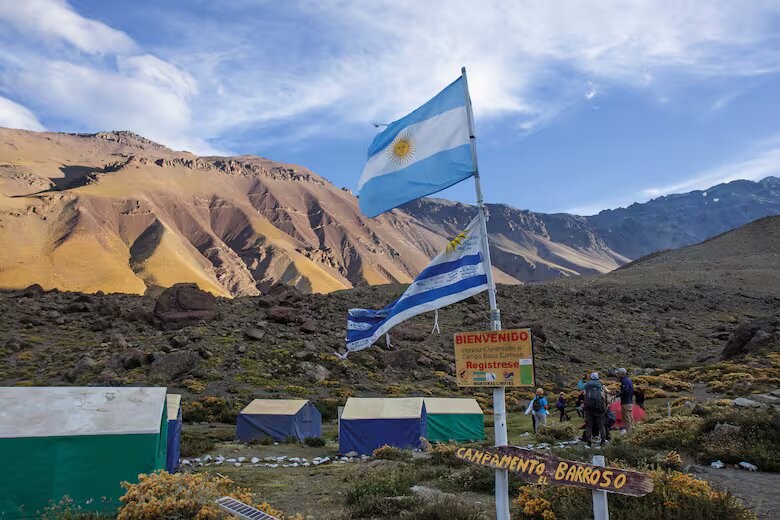
At six in the evening we reach camp at El Barroso, at 2,550 masl. A hearty snack awaits us, sturdy tents to sleep in, and paths of white stone visible in the moonlight, showing us the way to the dining area and the restrooms.
“If it's completely dark,” Alexis continues, “the number of stars, the Milky Way, is amazing. It's the fifth-clearest sky in the world, that of the Andes at this altitude. And if the moon comes out, it's another experience entirely. You can walk anywhere lit up by its light. It rises behind El Sosneado, the mountain they used to see.”
While the local guides light a fire to roast a young goat, we gather in a circle. I talk with Alexis, Fiona, Judit and Marcio for more than an hour. The first time Alexis went to the Valle de las Lágrimas, he went up with Roberto Jorge Canessa, one of the survivors who crossed the mountains on foot, along with Fernando Parrado, to get help. “I never even dreamed of it, being in the place where it all happened, with one of them, and especially with Canessa… we got on the horses, crossed the Atuel, and right then he tells me: ‘Look, Alexis, do you see that path? That path over there is the one I used to see from the mountain Nando and I climbed.’” At the time they thought the path was just a natural formation and that's why they didn't take it. They say that, had they followed it, it would have taken them three days instead of 10.
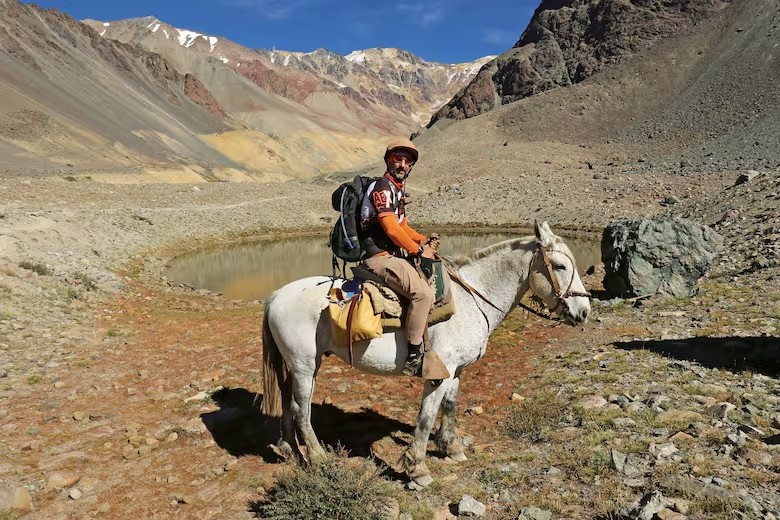
Fiona York, who has already been five times, talks about how majestic the route is. “I feel like part of nature when I'm here, I feel like the mountains have their own presence. The whole way to the cross completely absorbs me. As if nothing else existed in the world.” For Judit Castellà, on the other hand, it's her first time at the Valle de las Lágrimas. She'll be moved when she reaches the glacier, and days later, she'll recall the night she spent at the base of the memorial. “In the silence of the night we also heard unfamiliar sounds that left us uneasy, surely from the glacier's ice cracking, caused by the temperature difference between day and night. It's all very surreal.”
Marcio López is the last to speak, and the reason for his trip is to thank the local guide Osvaldo Araya (brother of Antonio, who found the surviving Uruguayans) for saving his life 31 years ago. He was 21 and had traveled there with a journalist, and a few others, to look for one of the crashed plane's batteries. Shortly after arriving, the weather turned brutal. Some wanted to keep going, but Osvaldo was firm and gave the order to turn back. The trail, buried under snow, had disappeared. They had to cross a gypsum field at 800 meters of altitude and didn't know where. Shouting, Araya told them to wait, went off, and came back with 12 cows. He sent them across one by one, and one by one they kept falling off the edge, until cow number nine stepped firmly, showing them where to cross the gypsum field. By then, Marcio's hands and feet were frozen. When they reached the station, Araya himself started slapping his limbs to get the blood flowing again. Today, 31 years later, he traveled to Mendoza to say thank you. “Being able to meet Araya in person was, for me, the most important part of the whole trip.”
The interview is interrupted because someone whispers in my ear. “Look up there, Guada.” We all turn our heads, a light crosses the sky. Some say it's a star, others insist it's a UFO, that it's not a plane. The sky glows and the slopes are faintly lit, the navy blue tents also gleaming under the small lights. The horses drink water from clearings, there's a scent of firewood in the air. It's a magical moment.
The next day we get up early. Fernando organizes the departure, the local guides saddle the horses, and one of the girls is genuinely upset because she felt sick the day before and today she's been told she can't come along. I think at first she doesn't understand, but really, they're looking out for her, and that puts me at ease; it means they're looking out for all of us.
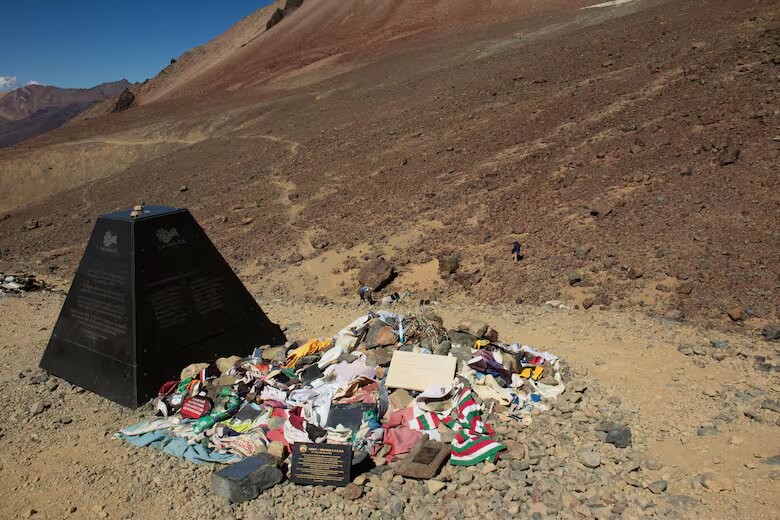
We'll ride eight hours on horseback. After the first two, crossing landscapes of lagoons and glacial valleys, we cross the Río de las Lágrimas. From there begins a significant climb up to 3,600 masl, where the plane's remains and the memorial with commemorative plaques are found. “There were ledges, cliffs, very intense descents… I hope the photos come out well,” I write in my travel journal.
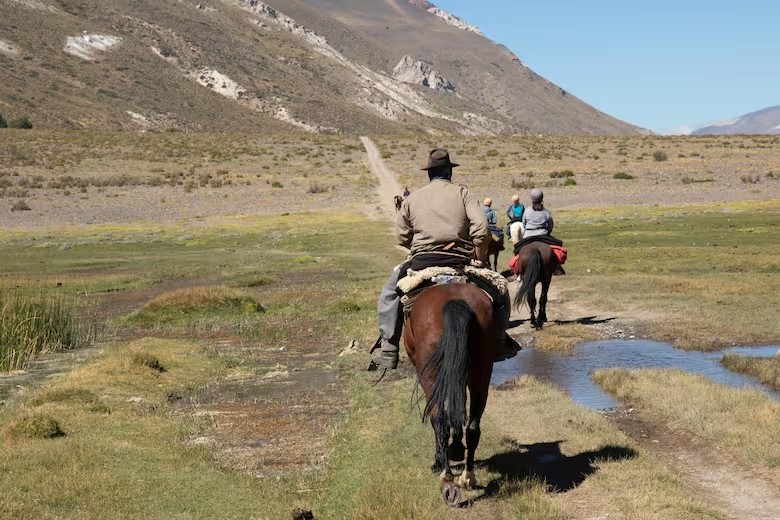
We ride in a line, one horse behind another, in silence. We're on the home stretch, each of us with our own thoughts, facing the mountain. When we reach the memorial, the silence deepens even further, the place commands it, you can hear the wind blowing.
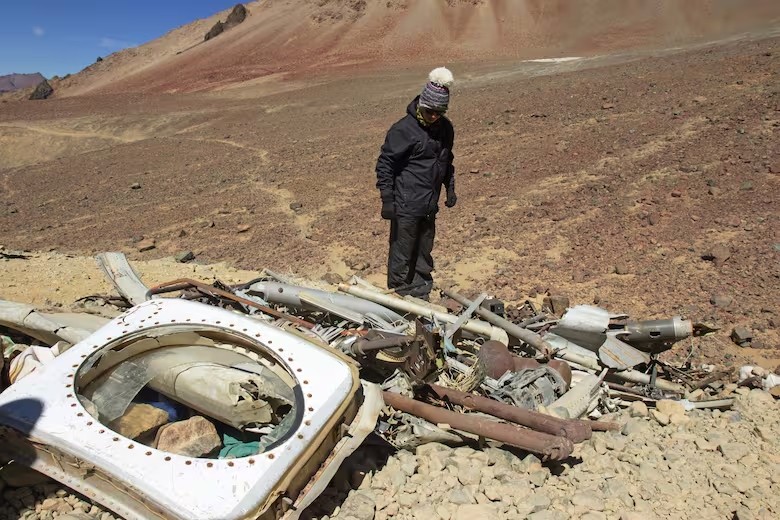
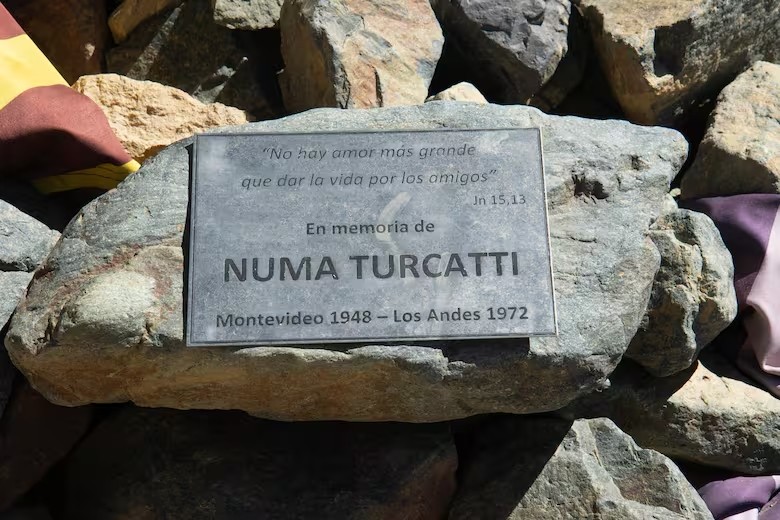
I walk over to where the plaques, scarves and plastic flowers held down by heavy stones are, and read the names. I look all around as if searching for something, I'm moved and hadn't expected to be. Judit is wearing a t-shirt from the Old Christians Rugby Club, where most of the flight's passengers used to play. Marcio looks at one of the plane's windows: “What strikes me most,” he said the night before, “is that the plane went down in a place that, under the sun, is a dreamlike landscape, and at the same time, in bad weather, is a true hell.”