April 29, 2026 · Facundo Noba Fioriti
For those looking to climb peaks or winter routes, cross glaciers, climb icy slopes, or simply venture into the majesty of snow and ice, choosing the right crampons becomes a crucial decision. Every detail matters with this essential tool for mountain lovers, from its weight and number of points to what you're going to use it for.
The first thing we'll look at is the types of crampons available, and how they're divided by their attachment system, their point types, and their suitability for different terrain.
Crampons by attachment system:
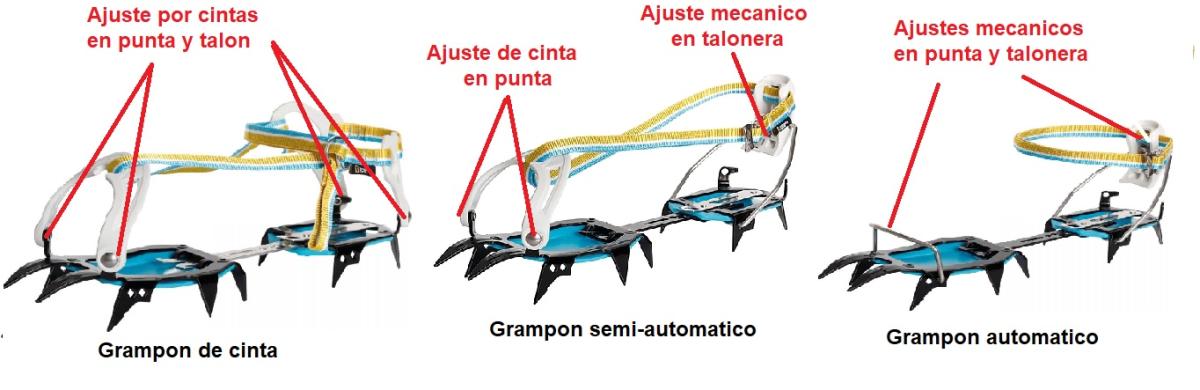
Strap-on crampons:.
This is the classic attachment system: a strap connects the front and rear sections and secures the crampon to the boot; you tighten it and you're set. This is the simplest type of crampon and can be used with any type of boot. Although with flexible trekking boots on steep terrain, the crampons can end up slipping off.
Step-in (automatic) crampons:
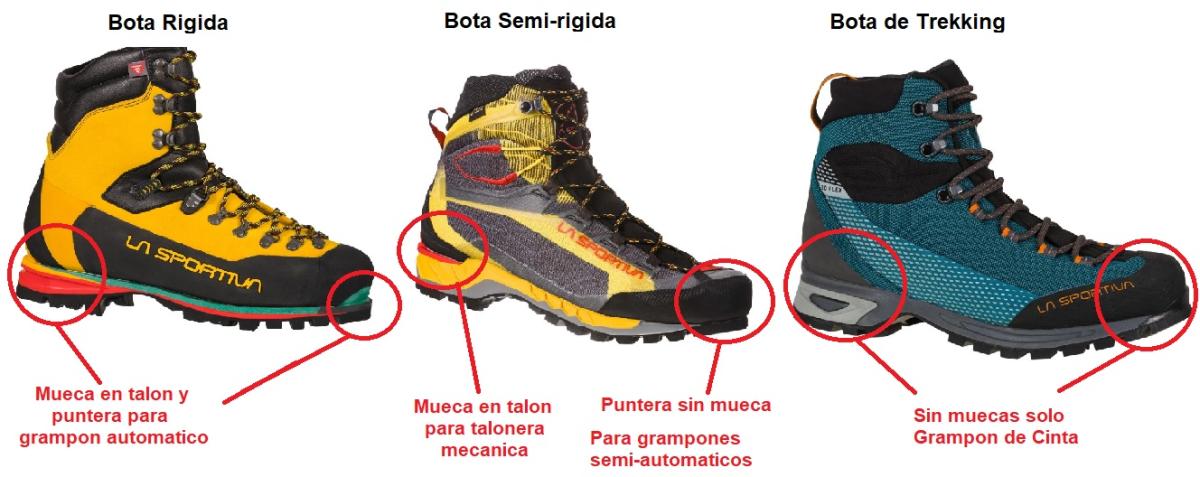
These crampons are made specifically for RIGID BOOTS, since those have the notches needed to use them.
Step-in crampons have a thick wire toe bail that fits into the front notch of the boot, and a heel lever that locks into the notch at the boot's heel, which is also designed for this system.
When fitting the crampon, you close the heel lever cam, locking the toe bail and heel piece onto the boot's notches, leaving the whole assembly attached to it. Finally, you tighten the heel strap, which, in case the crampon comes loose, keeps you from losing it and helps hold the heel piece in place. The crampon needs to be securely fitted, because if it isn't, it can end up coming off.
The advantages are:
- A very solid setup for alpine terrain.
- They're lighter than strap-on crampons.
- The boot-to-point distance can be adjusted for different terrain.
It's very important that the crampon fits the boot snugly; when buying one, remember to bring the boot you'll actually be using so it fits properly.
Semi-Automatic (Hybrid) Crampons:
These have a system that combines the two previous types, with a "strap" toe piece and an "automatic" heel piece. These are made for use with rigid and semi-rigid boots, since they require the heel notch. They work well for technical use, but lose some grip and can't have the boot-to-point distance adjusted like the fully automatic ones can, though they do increase the rigidity of the boot-crampon combination.
Multi-piece or modular:
A few years ago the brand Edelrid released the Shark model, which brings all three systems together in one. Later on Petzl did the same, selling modular crampons where you keep the same rear section and swap out the front piece depending on the use you'll be giving it.
In summary:
- Step-in (automatic) crampons can be used with rigid mountaineering and ski-touring boots.
- Semi-automatic crampons can be used with rigid or semi-rigid mountaineering and ski boots.
- Strap-on crampons can be used on any type of boot, from trekking boots to semi-rigid, rigid, and ski boots.
Crampons by front point type:
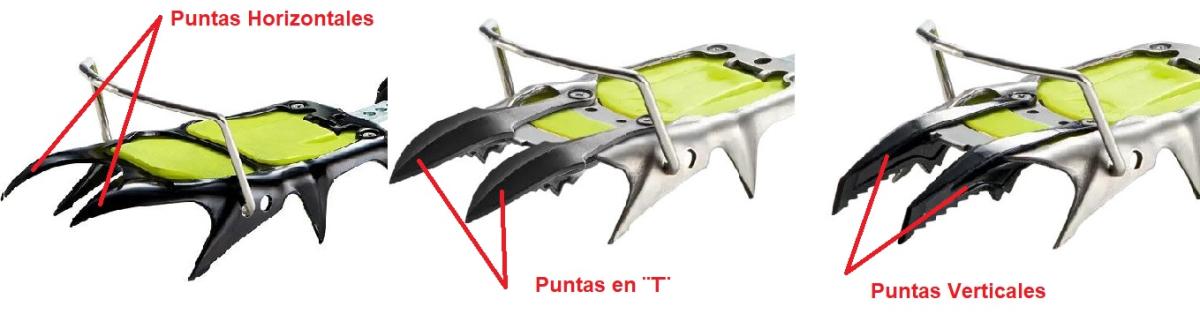
Crampons can be split up by different activities, and depending on the activity, they'll be more specific in terms of size, weight, number of points, and their shape. As you move from walking on snow and ice with a gentle slope to climbing ice gullies, steeper slopes, and vertical ice, the biggest change you'll notice is in the front points, since these become more specialized to bite better into the ice. They can be divided into 3 point types:
Horizontal-point crampons:
These are used for snow and ice activities with little technical complexity. This pair of points is horizontal with a downward curve; being horizontal, on snowy terrain they work by compacting the snow so you can walk more comfortably on it. They end in a sharp point to bite well into ice.
T-shaped point crampons:
For snow sections and slopes more technical than what horizontal points handle, but not as much as vertical points. This type of crampon already brings a hybrid between horizontal and vertical points, forming a T shape. These points are sturdier than horizontal ones and often have a saw-tooth type point system that helps them bite better into the ice. These can be used on steeper ice gullies and on climbs, though they're not recommended for rock.
Vertical-point crampons: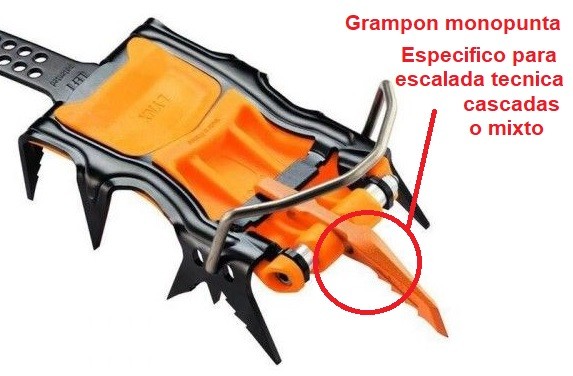
For vertical mountaineering and mixed climbing. This type of point emerged as a copy of ice-axe picks, creating a solid, reliable grip. There are dual-point and mono-point versions; mono-points are even more technical, designed for very precise climbing, allowing movements like a lateral pivot to shift your weight.
Crampons with interchangeable points:
Just as there are modular crampons with different attachment systems, there are also crampons with interchangeable points between T-shaped, horizontal, or vertical. These let you choose which points you want to use, and even use them as a mono-point setup, with several different fittings available.
By use on the terrain:
To wrap up regarding the types of crampons that exist, let's break them down by activity.
When it comes to buying crampons, we need to consider what we're actually going to use them for, since that will determine which one we should buy.
- For ice or mixed climbing: with vertical front points, either dual-point or mono-point.
- For technical mountaineering: with vertical dual-point front points, sturdy horizontal points, or T-shaped points.
- For trekking and mountaineering, with horizontal front points.
You could say that the crampon's point system and attachment type determine which one to choose, but you also have to consider the terrain you'll be using it on. The same crampon can be used on terrain it wasn't specifically designed for, but it won't be 100% effective, since horizontal-point crampons aren't the best for climbing, nor are vertical-point ones ideal for walking — though both can technically be used. It's probably best to have a different crampon for each need.