August 21, 2018 · Diario de la Pampa
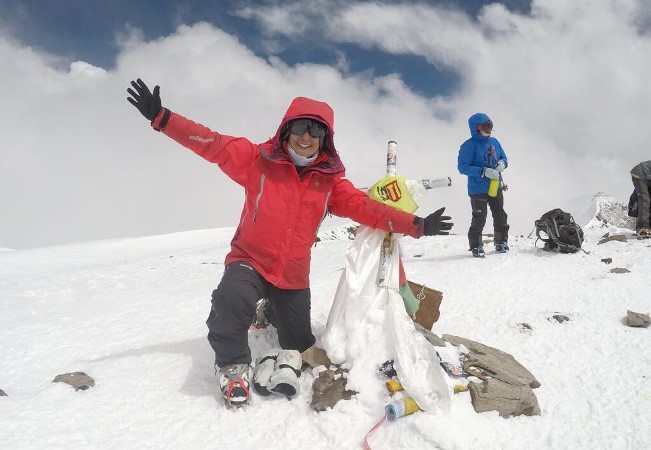
Patricia Bustos, from La Pampa, reached the summit on January 18th of Cerro Aconcagua, which, at 6960.8 meters above sea level, is the highest peak in the Americas. "It was an extreme test, but the result was more than positive," she told Diario Textual.
"I'm from Santa Rosa, a homemaker, and I have two daughters, ages 10 and 12, Inés and Lara. I had no mountaineering experience. In 2016 my husband and I went out to climb Cerro Penitentes, a peak at 4200 masl. I was 38 at the time, and when I was up there, on my first-ever summit experience, I got bitten by the Aconcagua 'bug,' and I told Ramiro, my husband, that for my 40th birthday I wanted to climb Aconcagua. I'd only done one summit, and not a very significant one, but the desire was there...
Right away I talked to the expedition guide (we went with a Buenos Aires company, Argentina Extrema) to see if my dream was completely crazy or if it could actually become real. Honestly, he didn't say yes, but he didn't say no either... So I got to work preparing. All through 2017, with the same company, I did several trips to different mountains with a bit more difficulty, to gain experience... because what I had was next to nothing. We went to Vallecitos in Mendoza, to Volcán San Francisco in Catamarca, and to Nevado de Chañi in Jujuy.
With those three under my belt I gradually gained a bit more experience with altitude, how my body felt, endurance, and so on.
Back home I was already into running, so I talked to my coach, Radamez González Tamayo, and we adapted my training for the mountains. We worked more on strength and endurance, rather than speed, which was what I'd been doing and enjoyed the most.
And just like that the year went by, and the big day arrived: on January 3rd of this year I set off for Mendoza with my backpack and my mule bag.
There I met the rest of the expedition members, five in total, plus guide Roger Cangiani (with our first summit, he reached his 28th).
We did the normal route. Originally we registered at Aconcagua Provincial Park to do a route called the 360. But since the weather didn't cooperate during the expedition, we prioritized the summit and did the normal route instead. After sixteen days of acclimatization, we made the summit!
It really was an extreme test, but the result was more than positive. Acclimatization was key to a successful summit. We spent the first night at Puente del Inca, then Confluencia Camp, a trek up to Plaza Francia to acclimatize, then camp at Plaza de Mulas, and from there on to the high camps. First two nights at Camp Canadá, then five at Nido de Cóndores, with hikes up to Camp Berlín to acclimatize.
We kept moving up from camp to camp for 16 days and set out for the summit from Nido de Cóndores. Usually you go for the summit from higher up, from Berlín or Cólera, but strong winds and snowfall kept us from being able to set up camp any higher. That meant an extremely long summit day. We set out at midnight on the 18th and didn't reach the summit until 3:30 in the afternoon. And then we had another six hours or so of descent back to camp. As for me, more than happy, and a dream that would have seemed unthinkable not long ago".
Right away I talked to the expedition guide (we went with a Buenos Aires company, Argentina Extrema) to see if my dream was completely crazy or if it could actually become real. Honestly, he didn't say yes, but he didn't say no either... So I got to work preparing. All through 2017, with the same company, I did several trips to different mountains with a bit more difficulty, to gain experience... because what I had was next to nothing. We went to Vallecitos in Mendoza, to Volcán San Francisco in Catamarca, and to Nevado de Chañi in Jujuy.
With those three under my belt I gradually gained a bit more experience with altitude, how my body felt, endurance, and so on.
Back home I was already into running, so I talked to my coach, Radamez González Tamayo, and we adapted my training for the mountains. We worked more on strength and endurance, rather than speed, which was what I'd been doing and enjoyed the most.
And just like that the year went by, and the big day arrived: on January 3rd of this year I set off for Mendoza with my backpack and my mule bag.
There I met the rest of the expedition members, five in total, plus guide Roger Cangiani (with our first summit, he reached his 28th).
We did the normal route. Originally we registered at Aconcagua Provincial Park to do a route called the 360. But since the weather didn't cooperate during the expedition, we prioritized the summit and did the normal route instead. After sixteen days of acclimatization, we made the summit!
It really was an extreme test, but the result was more than positive. Acclimatization was key to a successful summit. We spent the first night at Puente del Inca, then Confluencia Camp, a trek up to Plaza Francia to acclimatize, then camp at Plaza de Mulas, and from there on to the high camps. First two nights at Camp Canadá, then five at Nido de Cóndores, with hikes up to Camp Berlín to acclimatize.
We kept moving up from camp to camp for 16 days and set out for the summit from Nido de Cóndores. Usually you go for the summit from higher up, from Berlín or Cólera, but strong winds and snowfall kept us from being able to set up camp any higher. That meant an extremely long summit day. We set out at midnight on the 18th and didn't reach the summit until 3:30 in the afternoon. And then we had another six hours or so of descent back to camp. As for me, more than happy, and a dream that would have seemed unthinkable not long ago".