Trekking & mountaineering
10 Classic Mountains in Argentina - under 6000 meters
Details of Argentinas most outstanding ascents on low to mid-high mountain peaks and volcanoes
A route linking the 3 base camps of the Colossus of the Americas
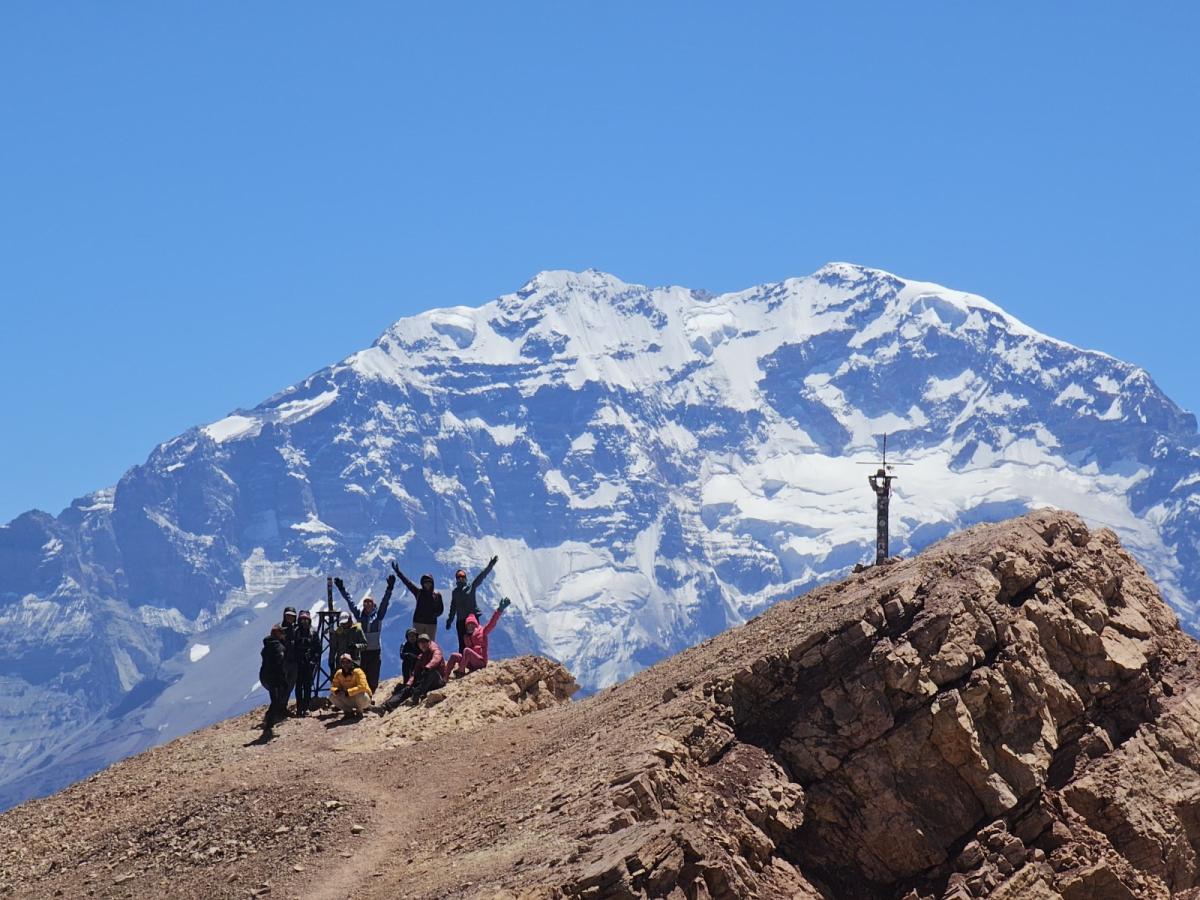
ACONCAGUA is one of the most visited mountains in the world; it is the roof of the Americas and of the entire Western Hemisphere. The desire to reach its summit at 6962 meters draws people from the most far-flung corners of the planet. The weather and high-mountain conditions make this expedition a one-of-a-kind adventure.
In this program we propose doing it in a different, less conventional way, going almost all the way around the Stone Sentinel, linking the Horcones and Vacas valleys and attempting the summit. Unlike the traditional "False Polish" route, here we enter via Plaza de Mulas and exit via Plaza Argentina, so we can also treat ourselves to visiting and getting to know the Plaza Francia camp, at the base of the legendary south face. An option with a bit more difficulty.
We build the group throughout the year, with physical and mental preparation and prior mountain outings. We hold group meetings beforehand with audiovisual materials and specific talks. We advise you on your gear throughout all the months leading up to the trip. It doesn't matter if you don't live in the city of Buenos Aires, where the training sessions take place.
We offer you an itinerary that includes progressive, staged acclimatization.
Argentinos al Aconcagua Project Group on Facebook: CLICK HERE
We recommend spending the night before in the city of Mendoza
Day 1: Mendoza: Morning meeting in the city of Mendoza. Introduction of guides, gear check, rental guidance, printing permits, packing mule bags, and other tasks. Last-minute shopping. Ask us about accommodation.
Day 2: Mendoza-Penitentes (2700 m). Transfer to the Aconcagua Provincial Park office to request and pay for trekking and climbing permits. Last-minute shopping. Transfer to Los Penitentes (2700 m). Check-in at a mountain hostel/refuge. Rest, short walks, hydration. Dinner and overnight.
Day 3. Pampa de Leñas (2950 m). Transfer to Punta de Vacas. Permit check by park rangers. First trekking section to Pampa de Leñas, 4 to 5 hours. Setting up camp. Rest and hydration. Grilled meat and vegetables for dinner. Overnight.
Day 4. Casa de Piedra (3250 m). Second trekking section to Casa de Piedra, a beautiful spot with the first view of Aconcagua's east face. Setting up camp again, rest, hydration, acclimatization. Dinner and overnight.
Day 5. Plaza Argentina (4250 m). On this day we climb through the Relincho Valley (the historic route of the 1934 Polish expedition) to Plaza Argentina, the Colossus of the Americas' east base camp. We'll settle into large tents with tables and chairs for comfort, plus setting up sleeping tents. Rest. Dinner and overnight.
Day 6. Plaza Argentina (4250 m). This day we'll rest at this base camp with short walks, hydration and good meals. Also a chance to enjoy the surroundings and its great views.
Day 7. Camp 1 (5000 m)-Plaza Argentina (4250 m). A load-carrying day for expedition members heading to the summit, up to camp 1 at 5000 m; we'll use this outing to get much closer to the great mountain, at Col Ameghino, next to the peak of the same name. Return to Plaza Argentina in the afternoon.
Day 8: Plaza Argentina (4250). Breakfast. Another rest day. Hydration and good meals. Short walks around the area to explore the camp, one of the largest in the world. Dinner and overnight
Day 9: Camp 1 (5000 m). Breakfast. First night spent above base camp. We climb the same route as on the load-carrying day. High-mountain tents. Hydration and meals. Rest. Dinner and overnight.
Day 10: Camp 1 (5000 m). Breakfast. Rest day at Camp 1 with a possible load-carry to Camp 2. Hydration and acclimatization.
Day 11: Camp 2 (5800 m). Breakfast. Climb up to the high-altitude camp 2. Rest, hydration and meals. Dinner and overnight.
Day 12: Cólera (5950 m). Breakfast. A long traverse crossing the mountain from the east side to the north side, to the Normal Route camp, Plaza Cólera. Overnight.
Day 13: Cólera (5950 m). Breakfast. Rest at Cólera. We prepare for the big day with good hydration and meals. Early to bed.
Day 14: Summit-Berlin/Cólera (6962 m - 5950 ). Very early, we set out on the day we've been waiting for so long. We climb to Independencia (6300 m), then cross the long traverse to the cave and begin the final push up the famous Canaleta to the main north summit of the highest mountain in the Americas. Photos, and after the celebration we begin the long descent to the Cólera camp. Rest and overnight.
Day 15: Plaza de Mulas (4350 m). Breakfast. Descent to Plaza de Mulas. Rest and recovery. Overnight.
Day 16: Horcones (2900 m) and the city of Mendoza. Descent trek to Horcones with mule-carried gear. Transfer to the city of Mendoza, to the hotel. End of the expedition and our services.
Day 17: Extra day in case of bad weather, or a wrap-up day in Mendoza.
Day 18: Extra day in case of bad weather, or a wrap-up day in Mendoza.
Ask us about booking accommodation in the city of Mendoza.
We offer you an installment payment plan in pesos so you can pay for your expedition throughout the year, in cash, by transfer/deposit, or by credit card.
The total is divided into 10 installments. You reserve with a deposit covering April-May (installments 1 and 2) and from June to January (installments 3 through 10) you pay monthly, with the price frozen in pesos.
Prior training: We have designed a schedule of outings meant to get you ready for this major goal. Every month we run outings to the sierras and mountains focused on physical, mental and technical training, to be ready for the big occasion of attempting great mountains like Lanín-Tronador-Domuyo-Chañi and many more...
Before the expedition we offer you an ascent of Cordón del Plata, as prior acclimatization, at 50% of the list price.
Rating for this 16-day Aconcagua ascent: M3-F5-T2-P5-A5
In our trekking, trekking-trek and mountaineering/climbing programs, we rate from 1 to 5 across the four points we consider decisive: backpack, physical, technical and psycho (psychological).
Backpack (M): This point has to do with the weight we have to carry in our backpacks. Treks or expeditions where we have pack animals allow us to carry less weight on our backs. Multi-day treks in Patagonia (without the option of pack mules) generally require us to carry more weight, especially in the first days.
Physical (F): We consider physical demand to be the strain we may experience, whether aerobic (climbs = possible shortness of breath), muscular (endurance = many hours walking), or on the joints (descents = knees/ankles).
Technical (T): Technical difficulty is based mainly on the terrain. How hard it is to climb a slope, whether it is very steep, or whether we need to use our hands in some sections (simple climbing), on rock or snow/ice, or gear such as crampons and ice axes on other ascents.
Psycho (P): We believe this point, the psychological factor, especially in ascents, is a significant one. Each person needs conviction, confidence, self-control and willpower to reach a goal. And depending on the attitude with which we face distances, elevation changes, terrain and many other objective factors, performance can vary widely.
Altitude (A): This is the degree to which altitude above sea level affects us based on the activity we are doing. Managing and overcoming altitude-related symptoms is the key to this point.
So, for two-day trips we can give these examples:
1- the classic trek with an ascent of Cerro Tres Picos in the Sierra de la Ventana, Buenos Aires province, a round-trip trek with one night camping in the sierras, which we can rate as: M2-F1-T1-P1-A1
2- the classic ascent of Lanín Volcano, in Neuquén, with one night at a refuge or in a tent, via the normal route: M2-F4-T2-P3-A2
And for 5-day to full-week trips, we can give these examples:
1- Round trip and ascent of Nevado de Chañi, Jujuy-Salta, with mule-carried gear
a) Trek without a summit attempt: M2-F3-T1-P2-A2
b) Trek with summit ascent (the difference is only marked on summit day): M3-F4-T3-P4-A3
2- Crossing the Andes trek via Paso Vuriloche, Patagonia: M5-F3-T1-P2-A1
As long as you are physically fit and able to follow the personal and/or group training plan we propose, and can do some prior trekking and mountaineering outings with us or on your own.
We'll advise you on this. Basically, almost everything can be rented; in Mendoza there's a store we work with that rents boots, jackets, pants, sunglasses/goggles, crampons, third-layer gloves and much more. There is gear that's better to buy, such as base layers, trekking footwear and clothing, poles, headlamp, some gloves and other items.
We are not walking every day. The expedition is long because the body needs a mandatory altitude acclimatization period; some days we just rest. The longest days are: the one from Confluencia to Plaza de Mulas base camp, with about 10 hours of walking, and summit attempt day (up to 20 possible hours of activity...).
We sleep at mountain camps in comfortable igloo-style tents for 2/3 or 4 people.
Tents are included in the service. We also include dining tents, structural tents, with tables and chairs
From 18 years of age.
Between 8 and 12 kilos up to base camp. 15 kg from base camp upward (except on summit day and rest days; on summit day only what you're wearing, water, headlamp and food)
We have a mule-portering service, which carries the group gear and any personal gear you're not using, up to base camp.
On all our expeditions we provide meals on a FULL BOARD basis.
Trail lunches (cold meals): Milanesa and tomato sandwiches, cold cut sandwiches, snack platters, salads, appetizers, etc.
Dinners: Vegetable, bacon and chorizo stew, chicken and vegetable casseroles, pasta with various sauces or stew, grilled meat, chow fan, chicken and rice casserole, pizzas....
Breakfasts and afternoon snacks: Tea, coffee, cappuccino, mate cocido, mate, powdered milk; bread, cookies, jam, honey, dulce de leche; cereal, fruit.
Individual snack bag with energy food: nougat bars, energy bars, nuts, chocolate, alfajores, candy, and more...
It is necessary to complete the personal/medical form to note if anyone has any dietary restrictions.
Scale 0–100%. Argentina Extrema graded difficulty system. How it is measured


We will reply by email or WhatsApp with full details, payment options and how to confirm.
Trekking & mountaineering
Details of Argentinas most outstanding ascents on low to mid-high mountain peaks and volcanoes
Trekking & mountaineering
The story of the plane that crashed on Cerro El Sosneado carrying thoroughbred horses, jewelry and a lot of m…
Trekking & mountaineering
The imagination gives illusions and insurmountable dream trips
Expeditions · Cuyo
from US$ 980
Expeditions · Cuyo