May 2, 2024 · Facundo Noba Fioriti
Climbing, like any outdoor sport, needs to be done safely, and for that it's necessary to have and understand the safety gear that's used.
In climbing, safety standards are very strict, since a mistake in the safety system can lead to serious injuries for the climber, and an accident can even be fatal.
The different forms of climbing will all agree on the minimum safety items, which are:
- Ropes.
- Harnesses.
- Helmet.
- Carabiners.
- Belay devices.
- Slings and cords.
Other additional items are more specific to the type of climbing being done, such as cams/nuts, ice axes, crampons, footwear, etc.
In this first installment we'll talk about ropes
The climbing rope is the item that connects the climber, via their harness, to the belayer. It runs through the protection placed on the wall, which prevents a fall to the ground. Like all safety gear, these ropes are subject to a standard, and the manufacturer must meet that standard in order to sell the product safely, since it must pass destructive and non-destructive testing, which gives assurance that the rope will hold up and can be used. These tests are carried out by the UIAA (International Climbing and Mountaineering Federation), and they're regulated by the European standard EN 892:2012.
How climbing ropes are made:
Ropes are made of petroleum-derived synthetic materials, such as polyester, polyamide (nylon) and polypropylene. Depending on the type of rope, the manufacturer chooses the synthetic fiber based on the characteristics they want it to have. They then determine the diameter, the number of strands, and the sheath to be used, and once finished, it must pass the quality controls of the European standard and the UIAA.
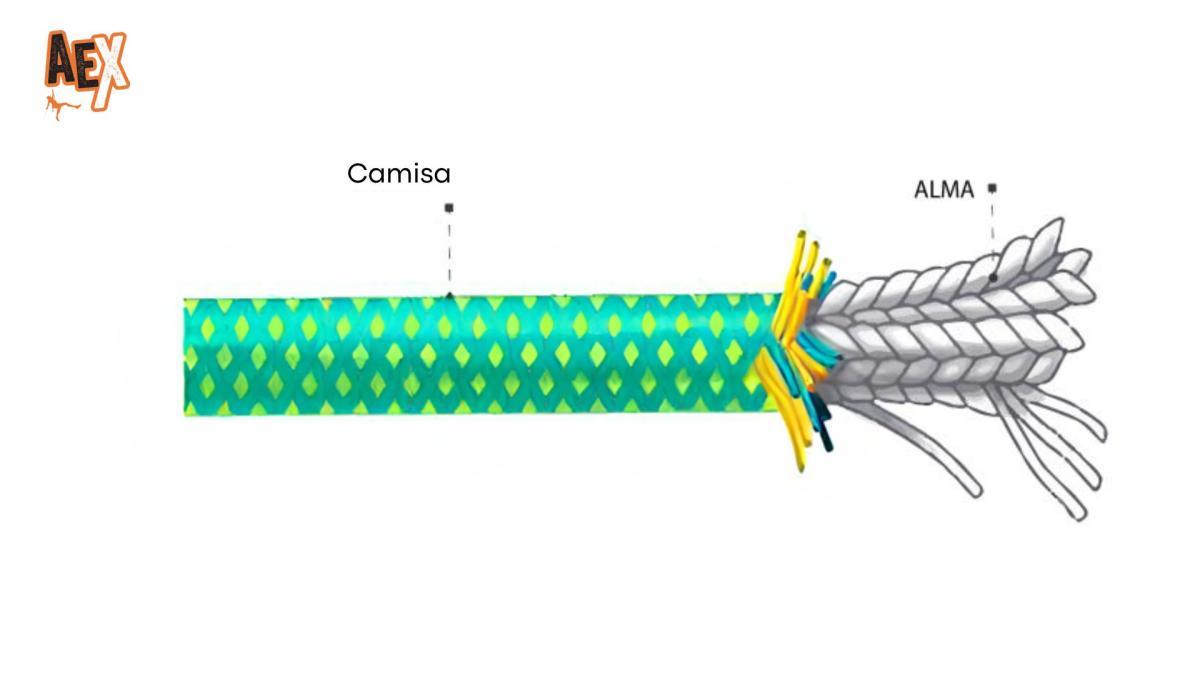
Ropes are made up of two parts:
- The core: the inner part, made up of thousands of strands of synthetic material running the full length of the rope, this is the strongest part of the rope, and the stretch of the rope differs depending on how it's made — if the strands are parallel, the rope is static or semi-static; if the core strands are braided, it will be a dynamic rope.
- The sheath: This is the outer part, protecting the core from friction, dust and abrasion. It also contributes a percentage of the rope's strength. This is the visible part and gives you a clue about the rope, since dynamic ropes are generally colorful, while semi-static and static ropes are usually white with black.
Among certified ropes, there are different ones for different uses, depending on the type of climbing and work. And you should never use a rope that isn't certified for one style or discipline for another style or another use. For example, you shouldn't use a half rope as if it were a single rope, or a semi-static rope for climbing.
Ropes by Elongation: Static, Semi-static and Dynamic.
Ropes have a stretch capacity, which is what absorbs force under tension. The greater the elongation, the more the rope will stretch under tension, and the lower the elongation, the less it will stretch under the same force, or almost not at all. This elongation is designed so that ropes stretch when they take impact from falls in climbing, which lets them act as a force dissipater, so the force isn't fully absorbed by the climber who fell.
Based on their elongation capacity, ropes are divided into 3 types:
Static Ropes:
According to the European standard, these are ropes with an elongation capacity of less than 3 percent. That's very little, so they're not suitable for climbing or mountain travel, since they break more easily. In mountaineering, semi-static ropes are often commonly called "static ropes." This can cause confusion; the important thing to know is that ropes certified as static should not be used in the mountains.
Semi-static Ropes:
Their elongation percentage doesn't exceed 5 percent. While their elongation is nearly the same as static ropes, this small amount of stretch gives them greater resistance to a jerk or small impact. They can't be used for rock climbing, but they can be used for hauling gear, canyoning, as fixed ropes in the mountains, for ziplines, work at height, etc. These are certified under the UNE-EN 1891 safety standard. There are 2 types of semi-static ropes:
- Type A: The strongest, used by professionals, with a minimum tensile breaking strength of 22kN, 5 falls of 100kg over the same rope length.
- Type B: Has lower strength; the most commonly used for small-group caving, canyoning, big wall hauling, fixing ropes, etc. These withstand a minimum of 18 kN and 5 falls of 80kg over the same rope length.
Dynamic Ropes:
These are the ones used in climbing, in their different versions. They can be used to belay the lead climber and hold falls, since their large elongation percentage is designed to absorb and cushion the fall. These are the classic mountaineering ropes, and the ones most commonly seen in the sport. They can be divided into 3 types based on the certification they hold. And each rope must only be used within the certification it received.
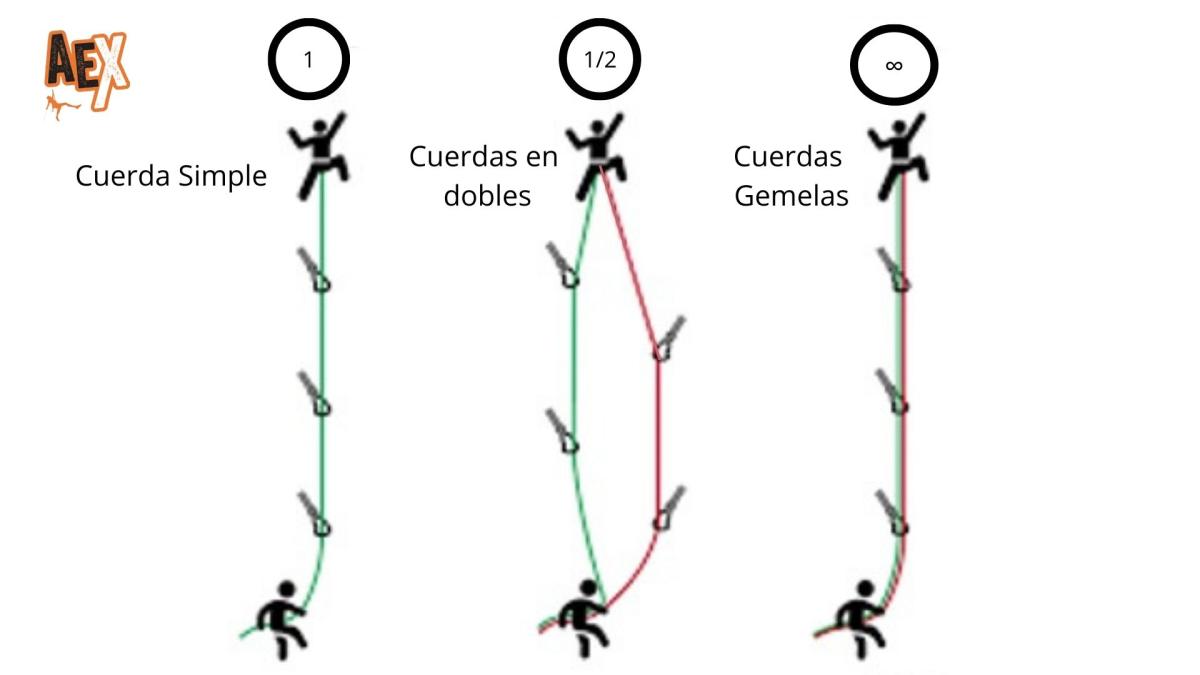
There are 3 certifications:
- Single Use Ropes (1): The most common climbing ropes, used in sport climbing and on vertical walls. This is the type used with a single rope, which runs through all the protection on the wall. These ropes have a thickness starting at 8.5mm and up. Their elongation is usually between 30 and 40%, and with an 80kg fall, sheath slippage must be less than 20 millimeters, and it must withstand a minimum of 5 falls with a factor of 1.77 at 80 kg. These are certified with the number 1 inside a circle. These ropes can come with dry treatments for ice climbing.
- Half Ropes (1/2): The most commonly used in alpine climbing; two ropes always have to be used together for safety, both certified as half ropes with the number (1/2) inside a circle. These have a smaller diameter than single ropes, and you climb by alternating the ropes through the protection, since it tends to be more spaced out; they also allow rappelling with both ropes, doubling the rappel length and reducing the number of rappels needed on a descent. If one rope gets cut, the other can still be used to rappel, and there's always a safety redundancy from using two ropes. These ropes come with dry treatment for ice climbing.
- Twin Ropes (∞): These ropes have the smallest diameter of the three, and are always used in pairs, but unlike half ropes, they must always both run through every piece of protection, since they're not strong enough to be used singly or as a half rope. The advantage is for when you need two ropes but less weight in the mountains, and you don't need them to be half ropes because the protection isn't spaced out that much, and it lets you use two ropes for double rappels.
Once we know what type of rope we'll need for the activity we're going to do, we start choosing based on its technical details. These will tell us about the rope's lifespan under different usage factors.
Impact Force
This is the force the climber experiences when the fall is stopped. This energy is generated when the climber falls, creating kinetic energy accelerated by Earth's gravity; that energy is called impact force. This energy is dissipated, so it doesn't harm the climber, through the rope and the safety system connecting them to the belayer. Ropes have their maximum impact force listed in the specifications. This number represents the maximum amount of force in kN that the climber's body would receive in a factor 2 fall (we'll talk about that in the next section). The lower this number, the better, since the climber would take less load in a fall.
Fall Factor
The fall factor is generally used to quantify the severity of a fall in climbing. In climbing, it ranges between 0 and 2.
The fall factor is the ratio between the number of meters fallen and the number of meters of active rope, the rope in use.
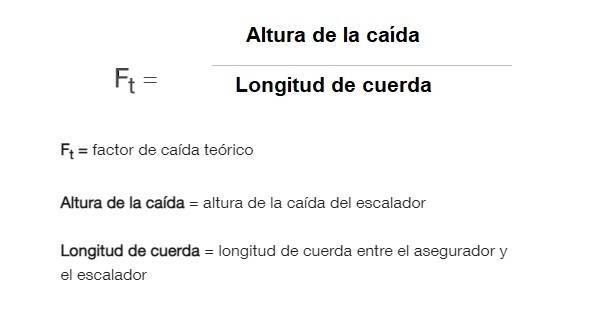
A higher fall factor indicates a greater impact force on the climber, so as a general rule, it should be lower than 1. Ropes are certified and tested to withstand a total number of falls under a factor of 1.7. The number of falls it can withstand at that factor, in the same spot, with an 80kg body, before breaking, is the number of falls listed in the rope's specifications. Generally these are a minimum of 5 falls.
To better understand this, we've illustrated it in the following image
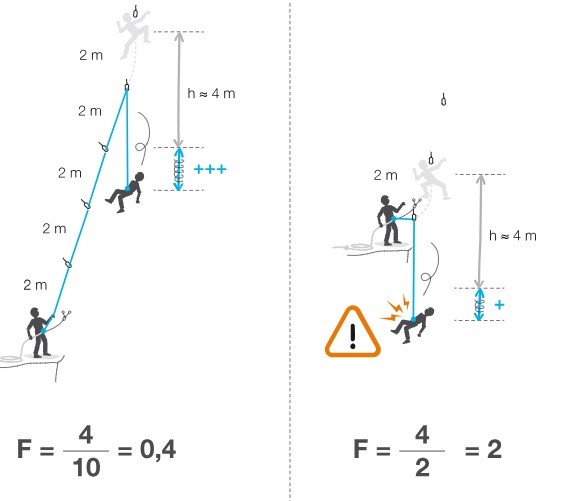
The same fall with different factors depending on the length of rope. Petzl diagram
In these two cases, the severity of the fall increases. The free-fall height is identical, so the energy to be dissipated is the same, but the system is less dynamic, and the climber takes a greater impact force in the second case.
Diameter and Weight
Larger-diameter ropes have a longer usable life. However, they're heavier and less easy to handle, especially with newer belay devices. Also, on routes where weight and smooth handling are essential, it's better to have a thinner rope. Performance is usually thought of as a ratio between weight and dynamic properties. For a fair comparison, it's better to compare the amount of material used per meter of rope than the diameter itself, since it's more precise — the amount of material doesn't change over time, while the diameter can change with use.
Sheath Slippage and Number of Strands
The core and the sheath of the rope are two independent components that tend to slide relative to each other. As a result, the sheath tends to gradually deform under the effect of the belay device, creating an area where it becomes loose around the core. With this phenomenon, the rope tends to wear out faster, in addition to possibly jamming due to use with safety devices, getting stuck in them.
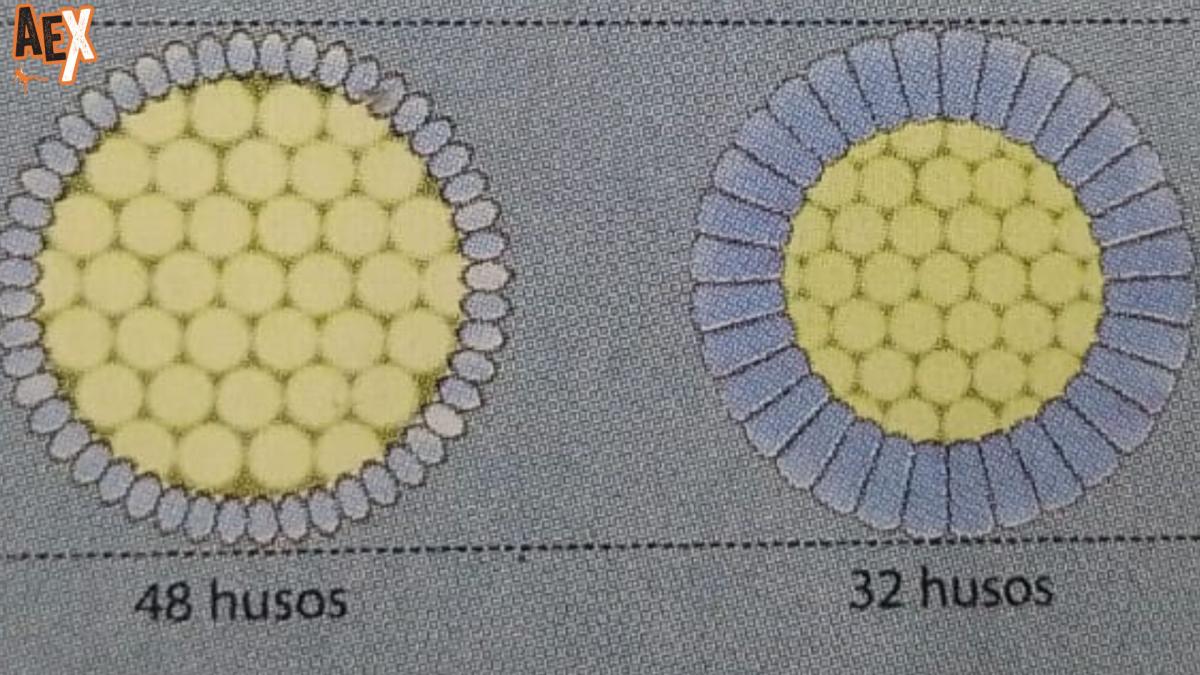
The sheath is made up of a group of threads, called strands. At the same diameter, a higher number of strands offers better dynamic performance, while a higher number of strands also offers better resistance to friction. So you'd choose a 32-strand rope if you want it more dynamic, and a 48-strand one if you want greater abrasion resistance.
Conclusion
Based on the information covered, we can conclude that there are ropes for different activities, among them those with greater elongation, which are for climbing, and those without it, static ropes for rigging. Among dynamic climbing ropes, there are also 3 types: single, for sport climbing and various uses, and half and twin ropes for alpine climbing and ice. And when it comes to choosing the one you need, you can also look at its absorption capacity via the impact force, and its durability and abrasion resistance via the number of strands and sheath slippage.
This gives you several pieces of information to help choose what type of rope you'll need for the activities you do, at the time of purchase.